About Ivan's Childhood
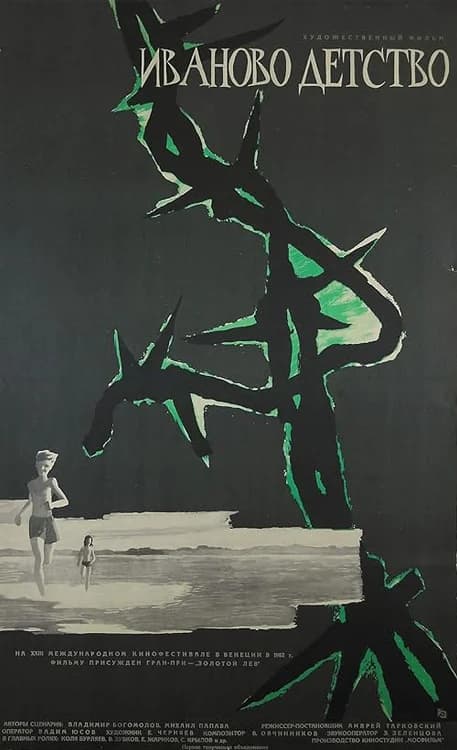
Andrei Tarkovsky's debut feature 'Ivan's Childhood' (1962) remains one of cinema's most profound explorations of war's impact on innocence. The Soviet masterpiece follows 12-year-old Ivan, an orphan who becomes a scout for the Soviet army during WWII, navigating the brutal Eastern Front with a maturity far beyond his years. Nikolai Burlyaev delivers a heartbreaking performance as Ivan, whose childhood has been stolen by conflict, leaving only haunting dreams of his lost past.
The film's power lies in Tarkovsky's poetic direction, contrasting Ivan's grim reality with ethereal dream sequences that reveal the childhood he should have experienced. These moments of lyrical beauty make the wartime scenes more devastating, creating a profound meditation on lost innocence. The supporting cast, including Valentin Zubkov and Yevgeny Zharikov as sympathetic officers who try to protect Ivan, adds emotional depth to this anti-war statement.
Viewers should watch 'Ivan's Childhood' not just as a war film but as a cinematic poem about memory, trauma, and what war destroys beyond the battlefield. Tarkovsky's visual mastery is already evident in this early work, with stunning black-and-white cinematography that influenced generations of filmmakers. The film's exploration of psychological trauma feels remarkably contemporary, making it essential viewing for anyone interested in how cinema can address the human cost of conflict with both brutal honesty and transcendent beauty.
The film's power lies in Tarkovsky's poetic direction, contrasting Ivan's grim reality with ethereal dream sequences that reveal the childhood he should have experienced. These moments of lyrical beauty make the wartime scenes more devastating, creating a profound meditation on lost innocence. The supporting cast, including Valentin Zubkov and Yevgeny Zharikov as sympathetic officers who try to protect Ivan, adds emotional depth to this anti-war statement.
Viewers should watch 'Ivan's Childhood' not just as a war film but as a cinematic poem about memory, trauma, and what war destroys beyond the battlefield. Tarkovsky's visual mastery is already evident in this early work, with stunning black-and-white cinematography that influenced generations of filmmakers. The film's exploration of psychological trauma feels remarkably contemporary, making it essential viewing for anyone interested in how cinema can address the human cost of conflict with both brutal honesty and transcendent beauty.