About Guess Who's Coming to Dinner
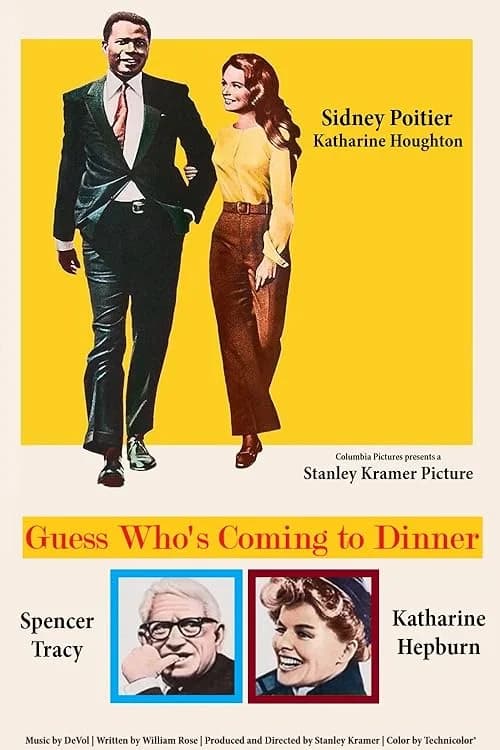
Stanley Kramer's 1967 classic 'Guess Who's Coming to Dinner' remains a landmark film in American cinema, deftly blending comedy and drama to tackle the urgent social issue of interracial marriage. The plot centers on Joanna Drayton (Katharine Houghton), who returns home to her liberal San Francisco parents, Matt and Christina (Spencer Tracy and Katharine Hepburn), with her brilliant and accomplished fiancé, Dr. John Prentice (Sidney Poitier). Despite their professed progressive values, the parents are thrown into a profound crisis of conscience, forced to confront their own hidden prejudices over the course of one tense evening.
The performances are nothing short of magnificent. Spencer Tracy, in his final film role, delivers a poignant and powerful performance, while Katharine Hepburn matches him with her signature grace and emotional depth. Sidney Poitier is impeccable as the dignified and patient John, a man who must navigate the subtle and overt biases of his future in-laws. The direction by Stanley Kramer is masterful, using the confined setting and real-time narrative to build palpable tension and genuine humor.
Viewers should watch 'Guess Who's Coming to Dinner' not only for its historical significance as a film released mere months before the Loving v. Virginia Supreme Court decision but for its timeless exploration of love, principle, and generational change. The script is witty and intelligent, and the emotional core of the story—the struggle between ingrained social norms and unconditional love—resonates as powerfully today as it did over fifty years ago. It is a beautifully acted, thought-provoking drama that is essential viewing.
The performances are nothing short of magnificent. Spencer Tracy, in his final film role, delivers a poignant and powerful performance, while Katharine Hepburn matches him with her signature grace and emotional depth. Sidney Poitier is impeccable as the dignified and patient John, a man who must navigate the subtle and overt biases of his future in-laws. The direction by Stanley Kramer is masterful, using the confined setting and real-time narrative to build palpable tension and genuine humor.
Viewers should watch 'Guess Who's Coming to Dinner' not only for its historical significance as a film released mere months before the Loving v. Virginia Supreme Court decision but for its timeless exploration of love, principle, and generational change. The script is witty and intelligent, and the emotional core of the story—the struggle between ingrained social norms and unconditional love—resonates as powerfully today as it did over fifty years ago. It is a beautifully acted, thought-provoking drama that is essential viewing.